Note: All Prints are Signed by the artist but do not have the text graphics that are shown on the sample images.
Col.
Al Whitley took over command of the 37th TFW with its cutting
edge equipment, the F-117 Nighthawk "Stealth Fighter" two days before
the whole group was relocated to Saudi Arabia in response to Saddam
Hussein's Iraqi invasion of its neighbor, Kuwait, in the summer of 1990.
Under his leadership the wing adapted the moniker "Team Stealth", and
were honed to a fine edge by the time hostilities began.
When Operation Desert Shield became Desert Storm in January of 1991,
Whitley was one of the first pilots over Baghdad, in the then-unproven
stealth aircraft. Though the Iraqi defenses threw everything they could
at the handful of F-117s, they were inevitably firing blind. As
impressive as the "Fireworks show" of anti-aircraft gunfire and missiles
was, no stealth fighter was even dinged by a stray shot (though shells
returning to Earth did a great deal of the damage reported by the eager
news media in populated civilian areas. Dropping laser-guided
bombs (LGBs), the handful of F-117s used in the Gulf War flew 2% of the
sorties by allied aircraft, but did 40% of the damage to Iraq's
strategic infrastructure - turning the Stealth fighter overnight into a
glamorous -but often referred to as ugly - superstar.
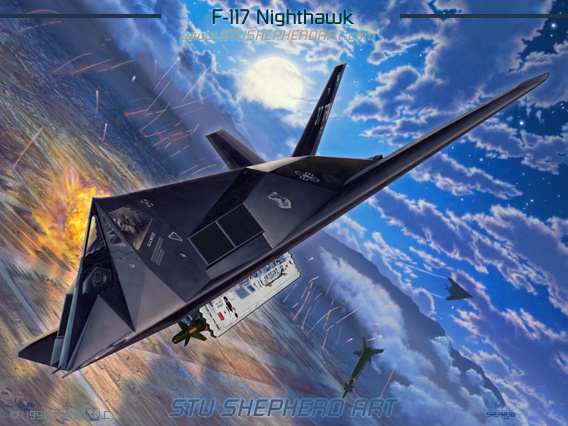
Here
Col. Al Whitley flies yet another of his 29 missions during the war,
this time striking deep into Iraq to further damage the command and
control systems. Aircraft #839 "Toxic Avenger" is seen here delivering
another payload at an airbase. . The Iraqi air defenses failed to
threaten the effectiveness of the F-117, but the cloudiest winter in a
decade did interfere with some missions. Only against a moonlight sky,
spied visually, could the F-117s be detected - but shooting one down
under even those condtions was another story.